Nigerian Grandmother Reveals a Simple 21-Day Home Method That Helps Mothers of Bedwetting Children Finally Wake Up to Dry Sheets — Without Alarms, Without Medication, and Without Another Ruined Morning
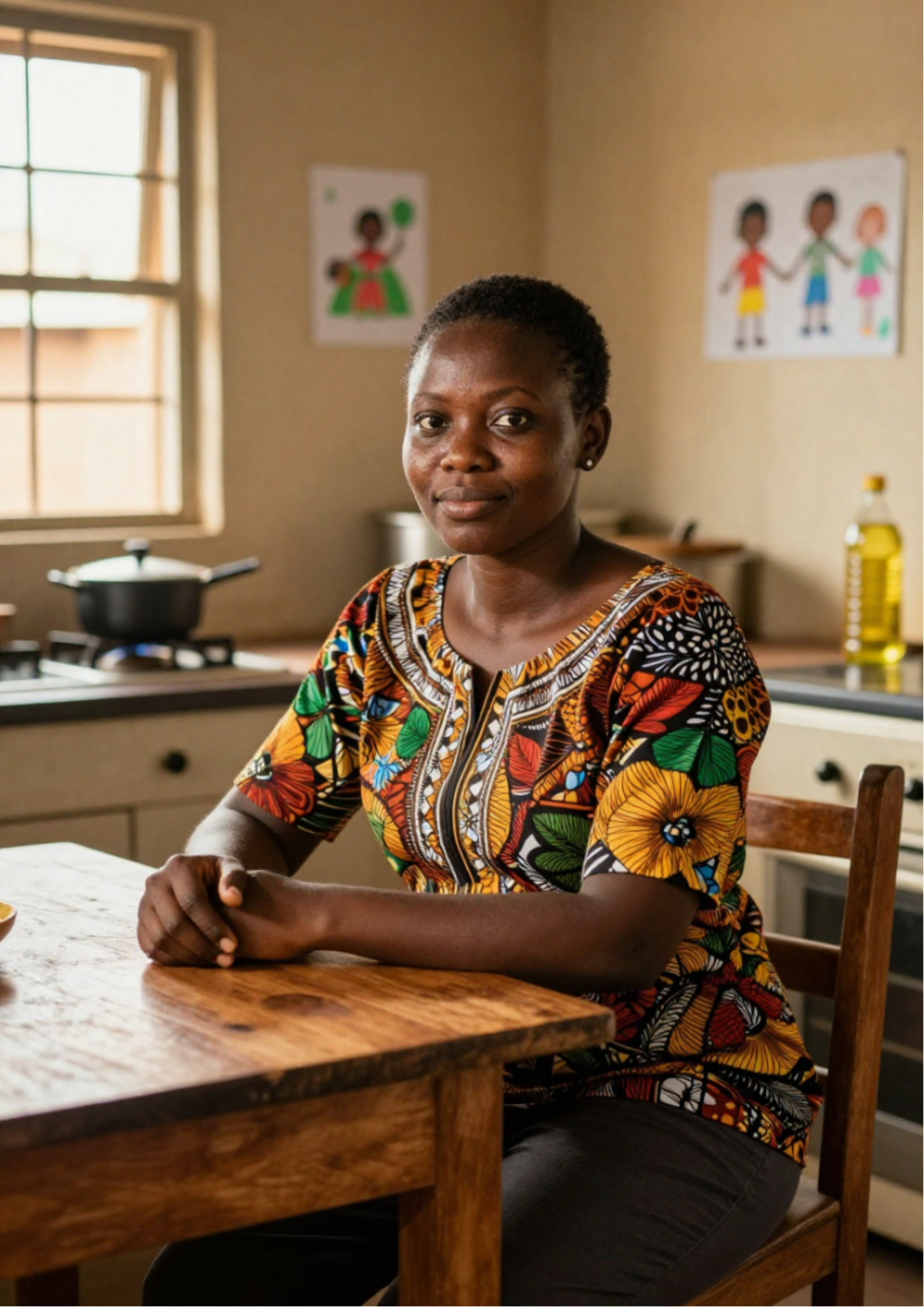
Every morning before your husband opens his eyes...
You are already up.
Not because the baby cried. Not because you couldn't sleep.
But because you need to get to that room before anyone else does.
You pull back the duvet quietly. You bundle the sheets. You carry them to the bathroom before the rest of the house is awake — and you do all of this in silence, because the alternative is a conversation you are not ready to have.
Three years of this. Three years of wet sheets. Three years of pretending everything is fine.
You have tried stopping his water by 6pm. You have set your alarm for midnight to wake him up. You have bought those plastic mattress covers that crinkle every time he turns. You have visited the pharmacy and listened to advice that did absolutely nothing.
You have prayed. You have fasted. You have asked your mother and she said "he will outgrow it." That was two years ago.
Last month, his school sent home a letter about the annual three-day trip to Ibadan.
He came to you with the letter in his hand, eyes bright with excitement.
And your stomach dropped.
Because you already knew. The bunk beds. The shared room. The other children. The morning.
You told him you'd think about it. He didn't understand why you were not as excited as he was. And that night, after he fell asleep, you sat on the edge of your bed and you cried. Quietly. Because you are always doing everything quietly.
You are not a bad mother. I want you to hear that clearly.
You are a mother who has been given the wrong information — or no information at all — about why this is happening and what actually stops it.
Drop everything you are doing now and listen to every word I'm about to say.
Our grandmothers did not have bedwetting alarms. They did not have paediatric specialists or NHS waiting lists. They did not have WhatsApp groups where mothers compare pharmacy receipts.
But their children stopped wetting the bed.
Quietly. Naturally. Without drama.
There was knowledge — passed from mother to daughter, from elder to young wife, from compound to compound — that our generation has largely lost. Not because it stopped working. But because modern medicine arrived with expensive gadgets, vague advice, and prescriptions that treated the symptom without touching the cause.
Hi. My name is Tolu. I write this blog from Lagos — though I spent three years in London before coming home, which is where part of this story happened.
First thing you should know about me: I am NOT a doctor. I am not a child psychologist or a paediatric specialist. I am just a mother of three who went through three years of wet sheets, school trip anxiety, and quiet morning shame — and eventually found the answer in the most unexpected place.
What I am about to share with you is not from a textbook. It is from a woman who has known these things her whole life.
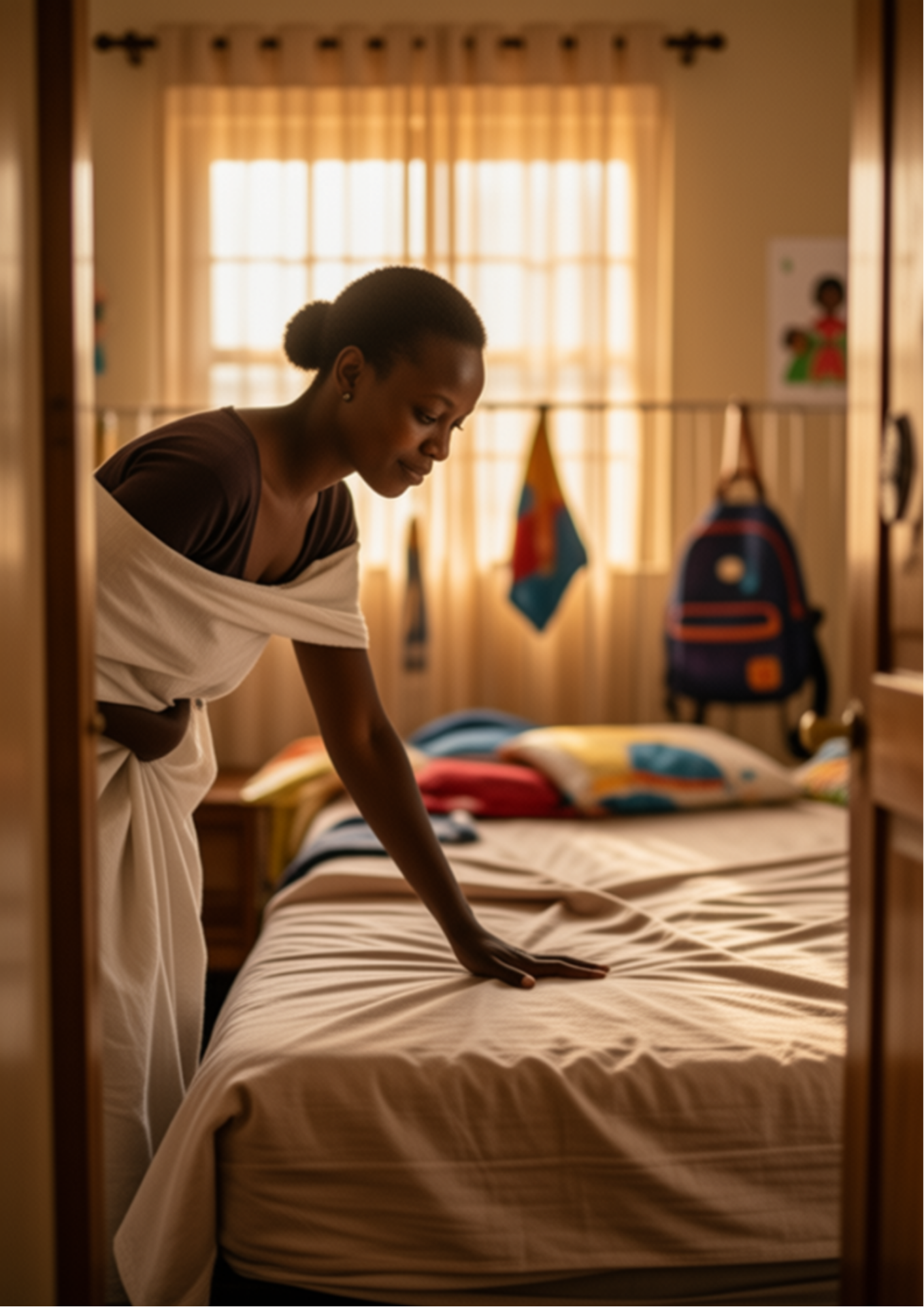
My son Emeka was four years old when I first noticed it was not going away on its own.
Every child wets the bed at some point. Every mother knows this. But there is a quiet understanding — an unspoken expectation — that by age five, six at the latest, it stops. You reach that age. You breathe. You retire the plastic sheet.
Emeka turned five. Then six.
Still wet. Every morning.
My husband Biodun was patient in the beginning. He helped me change the sheets without complaining. He told Emeka it was okay, that it would stop. He was kind about it. For a while.
By the time Emeka turned seven, the kindness had turned into a kind of heavy silence. Biodun stopped commenting about it. He just... stopped acknowledging it. Which somehow felt worse. Like it had become my problem to manage quietly. My failure to hide.
I started waking up earlier. 5:15am. Before anyone. Strip the bed, soak the sheets, spray the mattress, replace everything, make it look untouched. All before Biodun's alarm went off at 6am.
This was my life for almost three years.
The breaking point came the week before Emeka's school trip to Ibadan. He was eight years old. His class teacher had sent a permission form, a packing list, and a cheerful letter about the educational value of the trip. Emeka was not excited. He was terrified.
He came to me at night, after his younger sister was asleep. He sat on the edge of my bed and in a very small voice he said: "Mummy. What if it happens at school?"
I held him for a long time. I told him it would be fine. That we would figure it out. That he would be okay.
After he went back to bed, I sat in the dark for an hour and made a decision. I was going to fix this. Whatever it took. I was going to find the answer.
What I had already tried — and why none of it worked:
Fluid restriction after 6pm. The advice every mother gets first. Stop all water, juice, malt — everything — by early evening. We did this for four months. It reduced accidents slightly on some nights. But the moment I relaxed — one evening of malt drink — the full accidents returned. It was managing a symptom, not solving anything.
Midnight waking. I set my alarm for 12am every night and carried Emeka to the toilet in his sleep. It worked — on the nights I did it. But it was unsustainable. I was exhausted. And when I missed a night, he wet the bed. I was not fixing his bladder. I was just doing his bladder's job for it.
A bedwetting alarm from the pharmacy. The pharmacist in Surulere recommended a moisture alarm that clips to the underwear and sounds when wetness is detected. It cost me ₦18,000. Emeka woke up screaming the first three nights, too startled and confused to get to the toilet in time. His younger sister woke up too. The whole house was in chaos. I returned it after one week.
An online herbal mixture. Someone in a Facebook parenting group recommended a seller in Mushin who prepared a special herbal drink for bedwetting children. I paid ₦6,500 and collected it on a Saturday. Emeka drank it for twelve days. Nothing changed. The seller told me to continue for another month. I declined.
Prayer and fasting. I went before God sincerely. I asked our pastor to pray with us specifically for Emeka. Our pastor is a man of God and I believe in the power of prayer. But I also came to understand that sometimes God provides the answer through knowledge — and I had not found that knowledge yet.
"Just wait, he'll outgrow it." My mother. My mother-in-law. Two aunties. My neighbour. Every one of them said the same thing. Maybe they were right. But Emeka was eight. The school trip was in six days. Waiting was no longer an option.
It was my neighbour Mrs. Afolabi who first mentioned Mama Adunni.
We were standing outside our compound gate on a Tuesday evening, watching our children play. I had just admitted — for the first time to anyone — that Emeka was still wetting the bed. Mrs. Afolabi did not express shock or pity. She simply nodded slowly and said: "You need to go and see Mama Adunni. She is in Ibadan. She is my husband's aunty. That woman knows things."
She gave me a phone number written on a torn piece of paper.
I nearly did not call. What was an elderly woman in Ibadan going to tell me that three years of trying had not? But on Thursday evening, sitting in my car outside the supermarket because I could not face going back inside the house yet, I dialled the number.
Mama Adunni answered on the second ring. Her voice was warm and unhurried, the voice of a woman who has never been in a rush a day in her life. I explained Emeka's situation. She listened without interrupting. When I finished, there was a brief pause, and then she said:
"The child is not the problem. The problem is what you are putting in him in the evening. And the problem is that nobody has taught his body how to wake up. These are two separate things. Both must be fixed. Come and see me."
I drove to Ibadan that Saturday with Emeka. Mama Adunni is in her mid-seventies, small and sharp-eyed, with the calm certainty of a woman who has seen everything and been surprised by nothing. She lives in a bungalow in Bodija with a courtyard full of plants I could not name. She welcomed us with puff puff and Lipton and made Emeka feel completely at ease.
She asked me what Emeka ate and drank every evening. I listed everything. She nodded at certain things and raised an eyebrow at others. Then she looked at me very directly and said:
"You know what all those alarm people and pharmacy people never told you? There are foods — foods sitting in your kitchen right now — that tell a child's bladder to sleep at night. When the bladder sleeps, the child cannot feel the signal to wake up. Remove those foods after a certain time. Then teach the bladder to stretch properly during the day. Then add the evening ritual. Three things. Twenty-one days. I have done this for thirty-two children in this compound alone."
I did not immediately believe her. I sat across from this small woman in Ibadan eating puff puff and thought: this is too simple. If it were this simple, the pharmacist would have told me. The doctor would have mentioned it.
But I was out of options. And Emeka was sitting next to me looking at her plants. And the school trip was in six days.
I went home with three handwritten pages of instructions. That evening I made the first change — just one thing from Emeka's evening routine. I did not tell Biodun what I was doing. I did not want to raise his hopes or mine.
The first three nights were the same. Wet bed. Quiet morning. Sheets in the bathroom.
Night four was lighter — the wet patch smaller than usual. I told myself it was coincidence.
Night six.
I went into Emeka's room at 5:15am as usual, braced for the familiar heaviness of wet fabric.
The sheets were dry.
I stood there for a full minute. I pressed my hand flat against the mattress in three different places. Dry. Completely dry. I sat on the edge of his bed and I put my hand over my mouth.
Emeka stirred. He opened one eye and looked at me and said: "Mummy, why are you crying?"
I told him I was not crying. I was just checking.
Night seven: dry. Night eight: dry. Night ten: dry.
On the morning of day twelve, Biodun walked past Emeka's open door and noticed I was not in there. He found me in the kitchen making akara. He gave me a slow, puzzled look. "You didn't go to his room this morning," he said.
I said: "I didn't need to."
He stood very still. Then he sat down heavily in the kitchen chair and said nothing for a long time. Then: "How? What did you do?"
I told him about Mama Adunni. I told him about the three things. He shook his head slowly, the way you do when something both relieves and frustrates you at the same time — because it was so simple, and you lost so much time.
Emeka went on the school trip. He came back with photographs and a hand-drawn card for me that said "Thank you Mummy." He did not say what for. He did not need to.
Since then, I have quietly shared Mama Adunni's method with seven other mothers — two from my church, one from my office building, four from this very blog's WhatsApp group. Every single one of them has reported significant improvement within the first two weeks. Three of them had completely dry children within the 21 days.
Mrs. Chidinma from Enugu told me: "Tolu, my daughter is eleven. She has not had a dry week in four years. Day nine of this thing, she came to wake me up herself at 6am. I didn't understand why she was so excited until she showed me her bed. I knelt on the floor of that room and prayed."
Amaka from Peckham, London, messaged me at 11pm her time: "He slept at his friend's house last night for the first time. He is nine years old and he slept at his friend's house and nothing happened. I don't have the words for this."
Mrs. Funke from Abuja called me — she didn't even message, she called — and the first thing she said was: "Who is this Mama Adunni? I want to go and kneel at her feet."
I cannot personally call back everyone who messages me on this blog. I cannot individually share Mama Adunni's three-page handwritten notes with every mother who reaches out. I have tried — and there are simply too many of you.
So I did the only sensible thing.
I sat down and I wrote everything up. The full system. The dietary trigger list built around Nigerian foods. The bladder training exercises. The evening ritual. The exact timeline. What to expect in the first week. How to handle relapses. What to say to your child's teacher. The confidence rebuilding steps for the child after the dry nights begin.
I put everything — every single thing Mama Adunni shared with me, expanded and explained in plain English, organised into a clear 21-day protocol — into one simple guide.
Introducing...
The Old Mothers' Bedwetting Secret
What Nigerian Grandmothers Knew About Stopping Bedwetting That Modern Medicine Replaced With Expensive Alarms
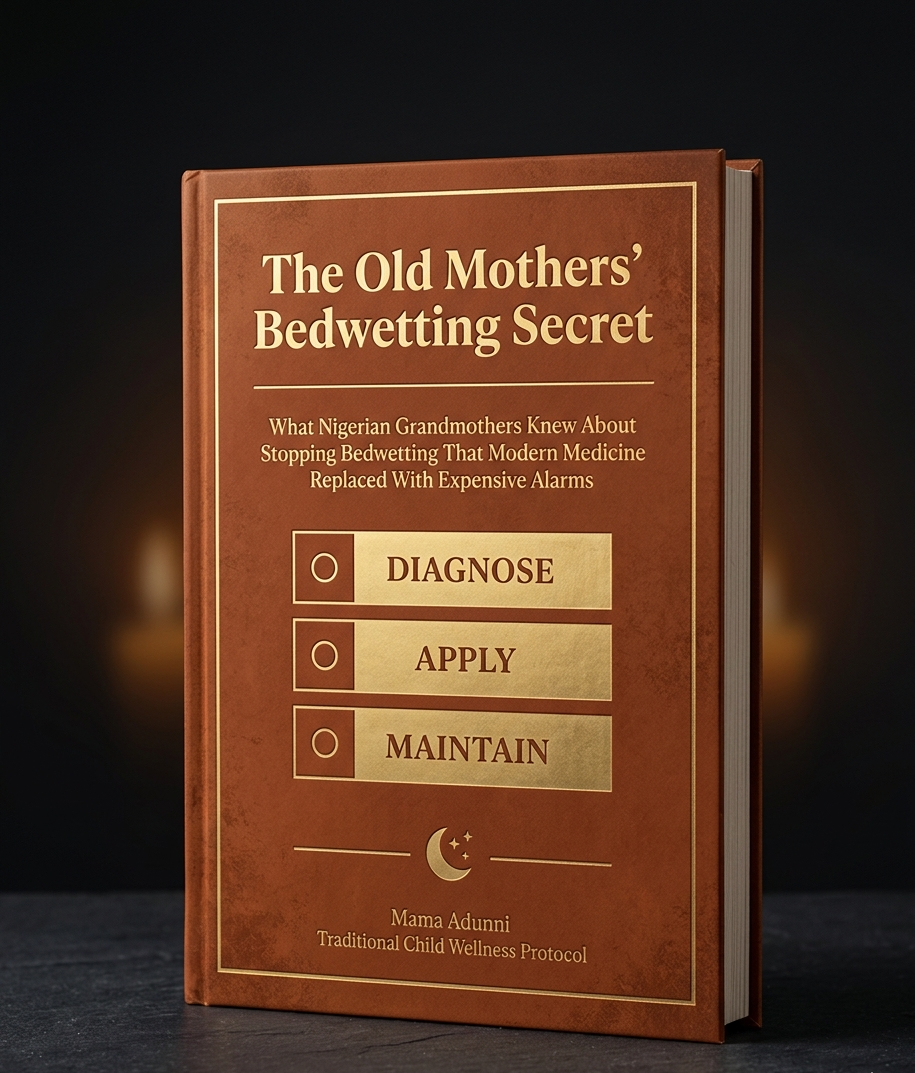
Inside This Guide, You Will Discover:
- The 4-Root-Cause Diagnosis — Pg. 3. Discover exactly which of the four root causes is driving your child's bedwetting before you apply a single remedy. This alone explains why nothing you have tried so far has worked permanently.
- The Nigerian Kitchen Trigger Food List — Pg. 8. The specific foods and drinks common in Nigerian homes that tell your child's bladder to "switch off" at night — including several that will surprise you completely. Remove these after a certain time and watch what changes.
- The Bladder Stretching Method — Pg. 14. A series of simple exercises done during the day (under five minutes) that train the bladder to hold more, feel more, and respond faster — the core physiological fix that alarms can never replicate.
- The 21-Day Evening Ritual Sequence — Pg. 19. The exact step-by-step routine for the hours before bedtime, in the correct order, with correct timing — the same sequence Mama Adunni has used for decades in Ibadan.
- The School Trip Preparation Script — Pg. 27. Word-for-word guidance on what to tell your child's teacher, how to prepare your child practically and emotionally, and how to send them to that school trip with confidence instead of dread.
- The Child Confidence Rebuilding Plan — Pg. 31. Because the dry nights are only half the battle. This section addresses the shame your child has been carrying and gives you a simple daily system to restore their self-esteem alongside their bladder.
- The Relapse Recovery Protocol — Pg. 36. If accidents return after dry nights — which occasionally happens — here is exactly what to do without panicking, without losing progress, and without letting the setback undo three weeks of work.
And the best part? You do not need to buy a single expensive alarm, visit a specialist, or explain your child's situation to anyone. It is the same simple method that worked for me — and has now worked for over 40 mothers I have quietly shared it with since returning from Ibadan.
⭐ Real Mothers. Real Results. Real Testimonials.
I am in London and I have been waiting EIGHTEEN MONTHS for an NHS referral to a paediatric specialist for my son. I almost gave up. A friend sent me this blog. My son slept at his friend's house last weekend for the first time in his life. He is nine years old. Nothing happened. I messaged Tolu at 11pm my time because I could not wait until morning. God bless this Mama Adunni. God bless this guide.
I bought this because the alarm my husband bought was causing more chaos than the bedwetting itself. The first week I was skeptical because the changes were small. Then week two started and e be like say something just clicked for my son. Dry night. Then another. Then four in a row. My husband now calls me "the bedwetting doctor" 😂. The bladder exercise section is the thing that made the real difference for us. Simple and effective. Thank you Tolu and thank you Mama Adunni.
My son's teacher had quietly suggested I "look into it medically" after a school trip incident last year. That was the most embarrassing moment of my parenting journey. I found this guide three weeks ago. My son had his first full dry week in four years last week. His teacher commented that he seems "more confident lately." I know exactly why. This thing works. Buy it. Don't waste another morning.
I am in Canada and I have been dealing with this since my daughter was six. She is now ten. The doctor here told me "some children just take longer." I almost paid $380 for a private assessment. Then I found this. ₦9,800 versus $380. And this actually worked. I want to cry typing this. Day fourteen was the turning point. Please if you are sitting on the fence just buy it. The worst that happens is you get a refund. The best that happens is what happened to us.
Share Your Experience
Just So You Know... Putting This Guide Together in a Clear, Easy-To-Follow Format Cost Me Over ₦120,000
- Two trips to Ibadan to sit with Mama Adunni and document her full method properly — ₦28,000
- Professional writer to help organise the content into a clear, readable guide — ₦35,000
- Medical research review to validate the bladder training section — ₦22,000
- Testing the protocol with twelve families over two months before publishing — time and resources
- Graphic design, layout, and professional PDF formatting — ₦18,000
- Website hosting and email support setup — ₦17,000+
I am not going to charge you ₦120,000...
I won't even charge you ₦60,000...
Not even ₦30,000...
In fact you won't even pay ₦15,000.
A more than fair price for everything inside would be just ₦12,500.
But today — for a limited time — your investment is just:
One payment. Instant download. Yours forever.
🔒 Secure payment via Selar · Instant download · Works on phone, tablet & computer
🎁 WAIT! I Have FREE Gifts For You...
If you are among the first 50 buyers, you will receive these two powerful bonuses alongside your main guide — completely FREE. (Today only.)
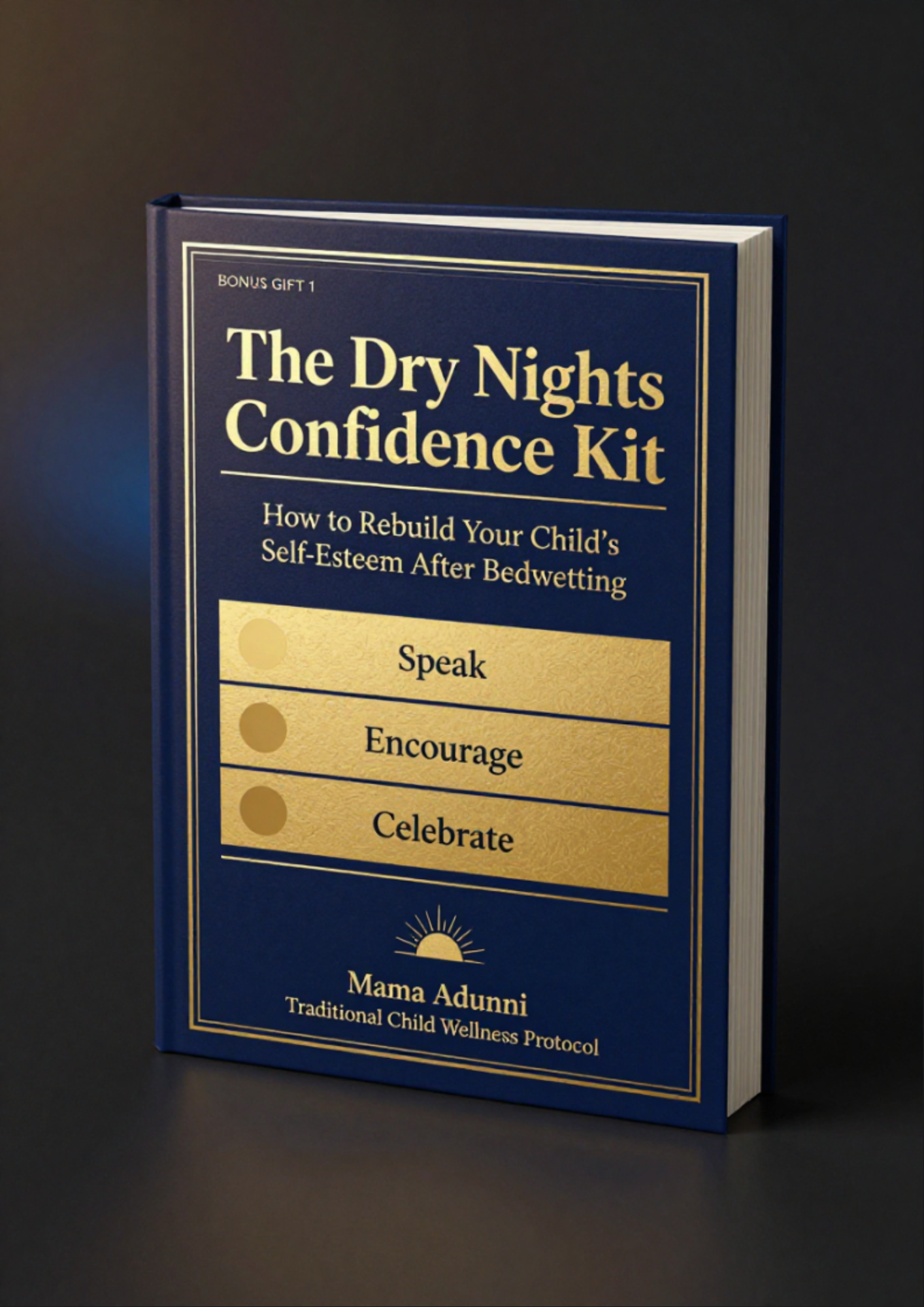
The Dry Nights Confidence Kit
How to Rebuild Your Child's Self-Esteem After Bedwetting — Scripts, Conversations, and a 21-Day Confidence Tracker. Because the dry bed is only half the victory. This bonus heals the emotional wound that years of bedwetting leaves behind in your child's heart.
Valued at ₦6,200 — yours FREE today.
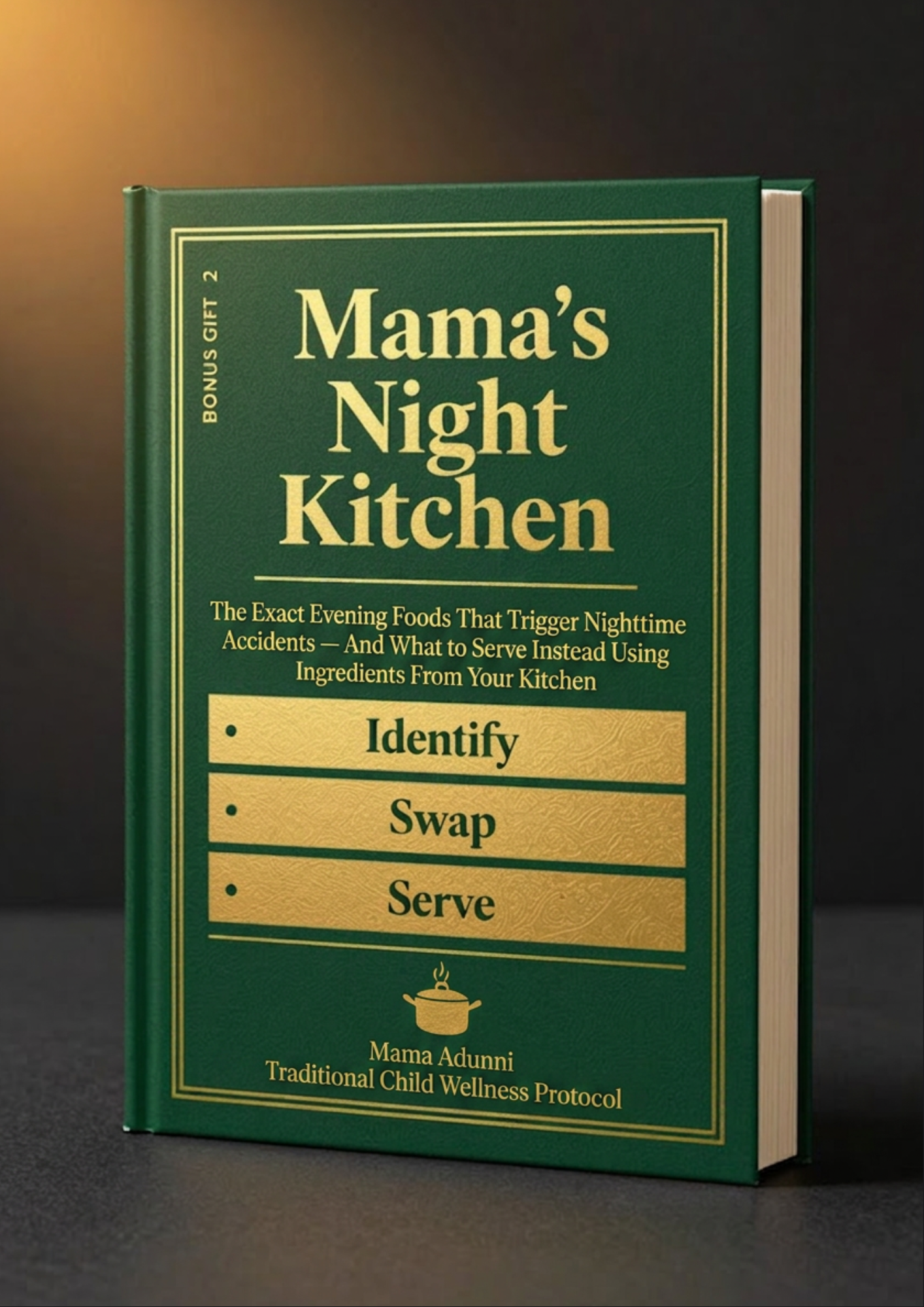
Mama's Night Kitchen
The Exact Evening Foods That Trigger Nighttime Accidents — And What to Serve Instead Using Ingredients From Your Kitchen. A practical, visual food swap guide built entirely around Nigerian ingredients. Stick it inside your kitchen cupboard door and use it from Day 1.
Valued at ₦9,500 — yours FREE today.
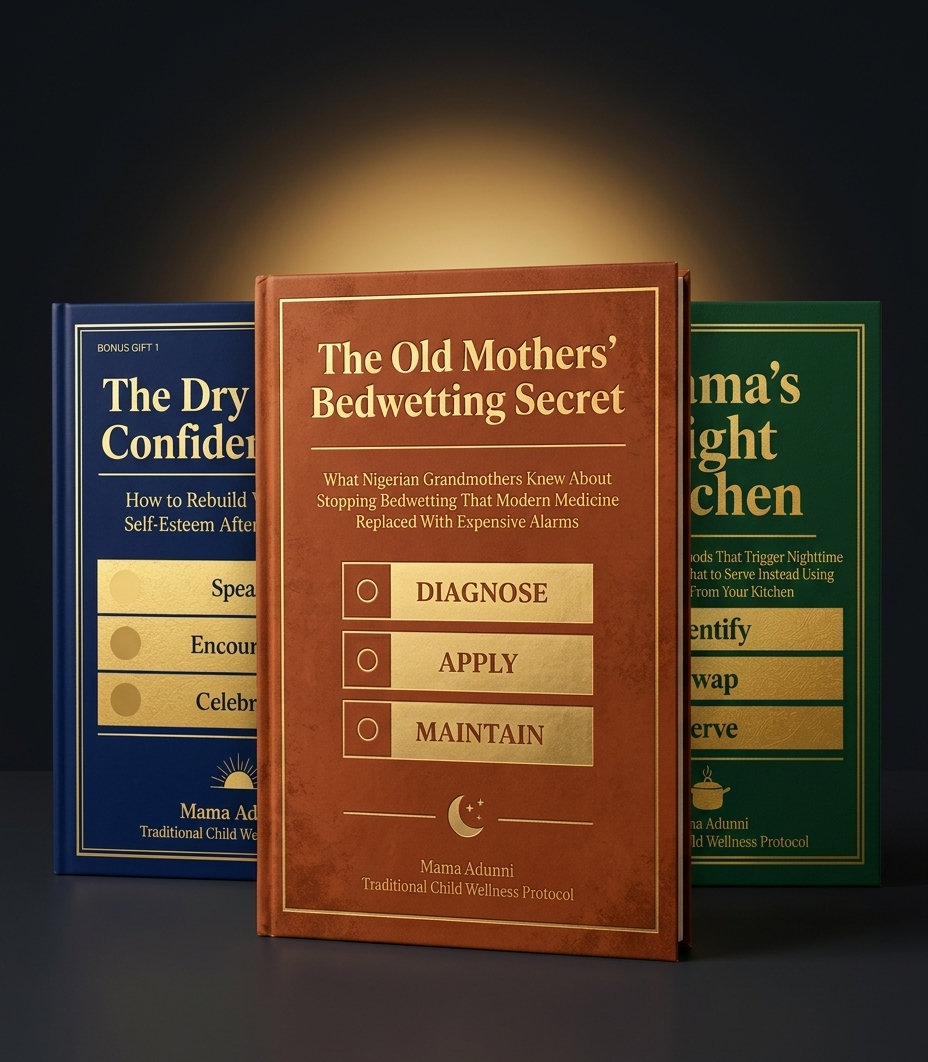
Total Bundle Value: ₦17,800
Your Price Today: ₦6,200
🔒 Secure payment · Instant access · 30-Day money-back guarantee
👀 See What Is Happening Right Now...
37 people have already taken advantage of this discount...
Only 13 spots remain at the ₦6,200 price.
Bear in mind — you are not the only person viewing this page right now.
⚡ I Want My Copy Now — Before the Price Goes Back UpOnly 13 discounted copies remaining
Still Feeling Unsure? I Completely Understand.
Which is why I am making you a bold, completely risk-free promise:
Download the guide today. Implement the 21-day protocol with your child. If you do not see meaningful improvement in your child's bedwetting within 30 days — if you follow the steps and nothing changes — send me one email and I will refund every kobo. No questions. No forms. No waiting.
You have absolutely nothing to lose. The only risk is continuing to strip wet sheets every morning when the answer is sitting right here for less than the cost of one pharmacy visit.
30-Day Full Money-Back Guarantee. Zero Risk. Zero Questions.
✅ Yes — I Want Dry Mornings. Get Me The Guide Now.
⭐ More Mothers. More Results.
My son is twelve. I had genuinely given up. I thought this was just his reality — that he would be managing this into secondary school. My friend sent me this blog link at 1am and I read the whole page that night. I downloaded the guide immediately. By day eleven something changed. By day seventeen he had his first dry week ever in his life. EVER. He is twelve years old. Please do not give up on your child. This works.
I am a father and I want to leave this comment because most comments here are from mothers. My wife and I were both going crazy with this situation. I found this guide after researching online for three hours one Saturday. The bladder training exercise section — that is what did it for our boy. Simple daily exercises. We did not even do everything perfectly and we still saw results from week two. Money well spent. Ten times over.
The NHS gave us a referral appointment for 14 months away. FOURTEEN MONTHS. My daughter is eight. I cannot wait 14 months. This guide cost me less than my bus fare for a week. The food trigger list is the section I keep going back to. We removed two things from her evening routine and the change was visible within five days. I am recommending this to every Nigerian mother I know in Birmingham. Absolutely brilliant.
I am from Ibadan so when I read that Mama Adunni is also from Ibadan I felt something. These elders know things. My sister's son benefited from traditional knowledge like this years ago. I sent this guide to three people in my family WhatsApp the same day I downloaded it. Two of them have already reported results. The evening ritual section — do not skip it. That part is powerful. God bless the person who put this together properly.
My daughter is nine and she had completely stopped telling me when she wet the bed. She would just leave the sheets and pretend nothing happened. I knew it was shame. The confidence rebuilding section of this guide made me cry because it described exactly what she was doing and why. We worked on that part alongside the physical protocol. Today she comes to tell me when she has a dry night. She is proud. That is the real result. Not just dry sheets — a happy child.
You Have Two Choices Right Now.
Get The Old Mothers' Bedwetting Secret. Implement the 21-day protocol. Remove the trigger foods. Do the bladder exercises. Follow the evening ritual. Wake up on Day 6, Day 9, Day 14 and press your hand flat against a dry mattress. Watch your child pack their own bag for a school trip. Watch them sleep at a cousin's house without fear. Watch them stop hiding from their own mornings. Take back the confidence this problem has stolen from both of you.
Go back to the midnight alarms. Go back to the pharmacy. Go back to "just wait, he will outgrow it." Wake up at 5:15am tomorrow morning and the morning after that. Keep making excuses for why your child cannot attend sleepovers. Keep answering your husband's silent looks with nothing. Maybe another mother who found this page will get the results you decided not to go after. Maybe this was exactly what you needed and you will only realise it when you are back here six months from now.
⏰ The clock is ticking. The 50-copy discount will not last. Your child's next school trip is already being planned.
₦6,200 only · Instant download · 30-day money-back guarantee · Secure payment
Questions? Email us at: mamasblogsupport@gmail.com
Results may vary. This guide is for informational purposes and is not a substitute for professional medical advice. If you suspect a serious underlying condition, please consult your doctor.
My daughter is eleven years old and I had almost accepted that this was just how life would be. Day nine of this protocol she came and woke me up at 6am herself. I didn't understand at first. She pulled me to her room and showed me her dry bed. I knelt on the floor of that room and cried and prayed at the same time. This guide is not a joke. It is real. The trigger food list alone changed everything — I had no idea watermelon in the evening was doing this.